
People
Ruth: the Moabite who chose Israel’s God
A widow from Moab, a nation barred from Israel’s assembly, Ruth follows Naomi home to Bethlehem and ends up in the family line of David and Jesus.
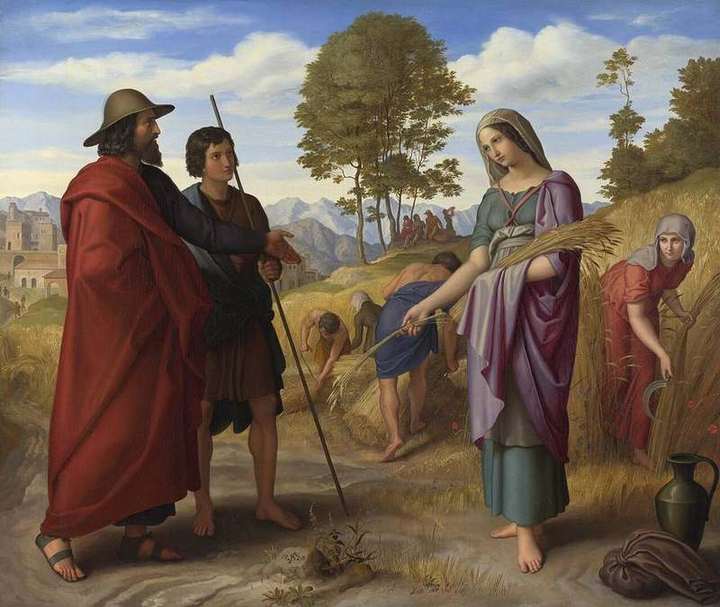
Key verse
Ruth said, “Don’t urge me to leave you, and to return from following you, for where you go, I will go; and where you stay, I will stay. Your people will be my people, and your God my God.”Ruth 1:16
World English Bible (public domain)
Who was Ruth?
A Moabite widow who married Naomi's son and returned with Naomi to Bethlehem.
The world Ruth lived in
Moabites were barred from Israel's assembly (Deut 23:3). Gleaning was the welfare law for the poor, foreigners, and widows. Spreading a cloak over a woman was a marriage proposal (Ezek 16:8).
What stands out
A foreign woman from a hated nation chooses Israel's God and becomes the great-grandmother of David.
What modern readers often miss
- 'Your God shall be my God' is a conversion oath.
- 'Spread your wing (cloak) over me' (Ruth 3:9) echoes Boaz's blessing about taking refuge under God's wings (2:12).
- Her being called 'a woman of worth' (3:11) matches Proverbs 31:10; in the Hebrew Bible order, Ruth follows Proverbs.
- Matthew names her among Jesus' ancestors.
The culture behind the text
Study notes
Key passages
How the Bible connects it
Every cross-reference in Lampstead says why it’s linked. A few from this page:
Ittai answered the king and said, “As Yahweh lives, and as my lord the king lives, surely in what place my lord the king is, whether for death or for life, your servant will be there also.”Ruth 1:16 → Ruth 2:11-12Why: Boaz praises her loyalty
Boaz answered her, “I have been told all about what you have done for your mother-in-law since the death of your husband, and how you have left your father, your mother, and the land of your birth, and have come to a people that you didn’t know before. May Yahweh repay your work, and a full reward be given to you from Yahweh, the God of Israel, under whose wings you have come to take refuge.”Ruth 1:16 → 2 Kings 2:2-6Why: Elisha refuses to leave Elijah
Elijah said to Elisha, “Please wait here, for Yahweh has sent me as far as Bethel.” Elisha said, “As Yahweh lives, and as your soul lives, I will not leave you.” So they went down to Bethel …Ruth 1:16 → Psalm 45:10Why: Forget your people and your father's house
Listen, daughter, consider, and turn your ear. Forget your own people, and also your father’s house.Ruth 3:9 → Ezekiel 16:8Why: God says he spread the corner of his garment over Jerusalem and made a covenant with her
“‘“Now when I passed by you, and looked at you, behold, your time was the time of love; and I spread my garment over you and covered your nakedness. Yes, I pledged myself to you and entered into a covenant with you,” says the Lord Yahweh, “and you became mine.”Ruth 3:9 → Ruth 2:20Why: Naomi named Boaz a redeemer
Naomi said to her daughter-in-law, “May he be blessed by Yahweh, who has not abandoned his kindness to the living and to the dead.” Naomi said to her, “The man is a close relative to us, one of our near kinsmen.”Ruth 3:9 → Ruth 3:12Why: Boaz must first deal with the nearer redeemer
Now it is true that I am a near kinsman. However, there is a kinsman nearer than I.Ruth 3:9 → Ruth 2:10-13Why: Ruth's request builds on Boaz's earlier kindness at the field
Then she fell on her face and bowed herself to the ground, and said to him, “Why have I found favor in your sight, that you should take knowledge of me, since I am a foreigner? …
Study this deeper in Lampstead
Read Ruth 1 with verse-by-verse study notes, cross-references that explain why they’re linked, people and places. Free during the beta.
Open Ruth 1See all Lampstead appsRelated
Sources behind these notes: Deut 23:3; Lev 19:9-10 gleaning law; Ruth 4 kinsman-redeemer law with Deut 25.; Keil & Delitzsch, Commentary on the Old Testament (1866–91); Easton's Bible Dictionary (1897), "Naomi"; Matthew Henry, Commentary on the Whole Bible (1706). Bible text: World English Bible (public domain).