
People
Who was Boaz?
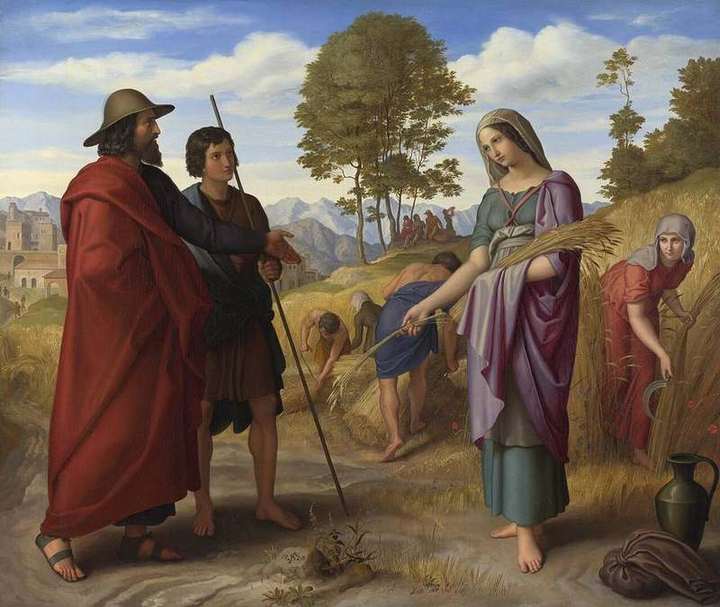
A landowner in Bethlehem in the days of the judges, Boaz is the kinsman-redeemer who marries Ruth and becomes the great-grandfather of King David.
Key verse
May Yahweh repay your work, and a full reward be given to you from Yahweh, the God of Israel, under whose wings you have come to take refuge.Ruth 2:12
World English Bible (public domain)
Background
A wealthy landowner of Bethlehem, a relative of Elimelech.
The world Boaz lived in
A kinsman-redeemer (go'el) bought back land and could marry a widow to raise an heir for the dead. Legal business was done at the town gate before elders. A sandal was handed over to seal a deal.
What stands out
He goes beyond the law, protecting and providing for a foreign widow. He is a picture of Christ as redeemer.
What modern readers often miss
- The nearer kinsman refused because the son would inherit for Elimelech's line, not his own.
- Matthew says his mother was Rahab, another foreign woman of faith.
- His first words, 'The LORD be with you,' show a godly landowner in an ungodly era (the time of the judges).
The culture behind the text
Study notes
Key passages
How the Bible connects it
Every cross-reference in Lampstead says why it’s linked. A few from this page:
“‘If your brother becomes poor, and sells some of his possessions, then his kinsman who is next to him shall come, and redeem that which his brother has sold …Ruth 4:4 → Jeremiah 32:7-12Why: Jeremiah redeems a relative's field
‘Behold, Hanamel the son of Shallum your uncle will come to you, saying, “Buy my field that is in Anathoth; for the right of redemption is yours to buy it …Ruth 2:12 → Psalm 36:7Why: Psalm 36 also pictures people taking refuge under God's wings
How precious is your loving kindness, God! The children of men take refuge under the shadow of your wings.Ruth 2:12 → Psalm 91:4Why: Psalm 91 also pictures taking refuge under God's wings
He will cover you with his feathers. Under his wings you will take refuge. His faithfulness is your shield and rampart.Ruth 2:12 → Psalm 63:7Why: Taking refuge under God's wings is the picture the psalmist sings of
For you have been my help. I will rejoice in the shadow of your wings.Ruth 2:12 → Psalm 17:8Why: Hide me in the shadow of your wings
Keep me as the apple of your eye. Hide me under the shadow of your wings…
Study this deeper in Lampstead
Read Ruth 2 with verse-by-verse study notes, cross-references that explain why they’re linked, people and places. Free during the beta.
Open Ruth 2See all Lampstead appsRelated
Sources behind these notes: Deut 25:7-10 sandal custom; Nuzi tablets on sandal transfers in land deals.; Easton's Bible Dictionary (1897), "Goel"; Keil & Delitzsch, Commentary on the Old Testament (1866–91). Bible text: World English Bible (public domain).